
The Learning Assistant (LA) Model leverages trained undergraduate peer leaders to partner with faculty in creating active, collaborative, student-centered learning environments that support meaningful engagement and success for all learners.
The Learning Assistant (LA) Model is an evidence-based approach to teaching and learning that leverages pedagogically trained undergraduate peer leaders to partner with faculty in creating active, collaborative, and student-centered learning environments. Learning Assistants (LAs) are not tutors or teaching assistants; instead, they facilitate discussion among small groups of students during class, encourage participation, and help students engage more deeply with their peers, instructors, and course content.
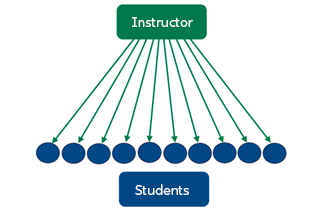
Traditional classroom setting (instructor - centered)
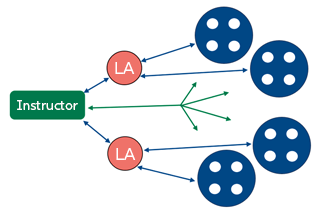
LA classroom setting (student - centered)
Originally developed at the University of Colorado Boulder and now implemented at
hundreds of institutions worldwide, the LA Model is grounded in the belief that students
learn best through active engagement, collaboration, and meaningful interaction. By
expanding the learning team and supporting evidence-based teaching practices, LAs
help create classroom environments where students actively construct knowledge, build
confidence, and take greater ownership of their learning.
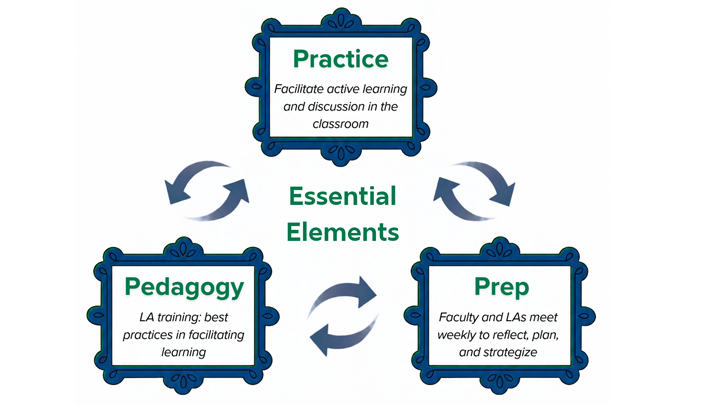
Essential Elements
The LA Model is grounded in three essential elements:
- Pedagogy – LAs receive training in best practices for supporting and facilitating student learning.
- Practice – LAs support students during class through active engagement and peer-to-peer interaction.
- Preparation – LAs collaborate weekly with faculty to advocate for students and prepare for upcoming activities.
What the Research Shows
Research has shown that the LA Model can increase student engagement, deepen learning, strengthen classroom communities, and improve student success. At its core, the LA model transforms the classroom into a collaborative learning community where students, faculty, and LAs work together to support meaningful learning for all.
This section is under construction. Please check back soon for more information.
LA Program Impact - Ä¢¹½TV
Ä¢¹½TV LA Program By The Numbers (Fall 2026)
3,000+
Students in LA Courses
87
LAs Hired
53
Faculty Working with LAs
49/84
Courses/Sections Supported
This section is under construction. Please check back soon for more information.