
The Global Engagement Office has formalized agreements with universities, research centers, and industry partners in 21 countries on 6 continents.
Types of International Agreements
Ä¢¹½TV (Ä¢¹½TV) seeks international agreements that build on the academic standing of the two collaborating universities. Securing and maintaining agreements with institutions abroad is one part of ¹ó³Ò°ä±«â€™s comprehensive internationalization effort under the Ä¢¹½TV Global Engagement Office. Our collaborations reflect the strategic goals of Ä¢¹½TV and provide the diplomatic framework for our international relationships. Any international partnership should benefit both institutions’ competitive advantage and promote cooperation in teaching, research, and student and faculty mobility. Ä¢¹½TV seeks and accepts collaborations with universities, institutions, government agencies, and other organizations operating outside the United States. Any agreement we enter must employ approved standard legal terms and conditions and meet SACS accreditation standards. We formalize these collaborations with differing degrees of specificity and formality.
The types of international agreements that Ä¢¹½TV enters into include:
-
Memoranda of Understanding (MOU)
Toggle More Info -
Memoranda of Agreement (MOA)
Toggle More Info -
Cooperative Agreements
Toggle More Info -
Fee for Service Agreements
Toggle More Info -
Student Exchange (Reciprocal)
Toggle More Info -
Affiliation Agreement
Toggle More Info -
International Cooperative Degree Agreements (Joint/Dual)
Toggle More Info -
International Affiliate Programs for Study Abroad
Toggle More Info -
Customized Educational Agreements
Toggle More Info -
Other Forms of Agreement
Toggle More Info
International Agreements Development Process
Ä¢¹½TV (Ä¢¹½TV) has a growing network of relationships with partner institutions abroad that enhances our international education efforts and extends the impact of our scholarly efforts. Our partnerships enable students and faculty to travel to and from our campus to enrich their own academic journeys. The Global Engagement Office (GEO) is prepared to develop and cultivate relationships that support ¹ó³Ò°ä±«â€™s broad institutional mission and strategic priorities. GEO manages the initiation, consultations, negotiation and signing of international agreements and ensures coordination with all stakeholders. Ä¢¹½TV welcomes new international agreements; however, GEO carefully approaches and assesses all new proposals. As the institutional steward of international partnerships, GEO sustains dialog with our international partners and monitors the activity and level of activity in all our partnerships. Our philosophy is that it is more beneficial to support quality programs than to maintain an extensive list of inactive, ceremonial partnerships. A further tenet of this philosophy is that ¹ó³Ò°ä±«â€™s international agreements reside at the university level with an aim to maximize collaboration among multiple units, and disciplines with our partners.
To propose a new international partnership agreement, follow this process to ensure appropriate support for the planned activity.
Step 1: Discussion
- The proposer must discuss the initiative with chair and dean to determine if an agreement is necessary. Ä¢¹½TV does not require or desire international agreements to accommodate the research activities of a single faculty member. Check the GEO International Agreements website to determine if there are already existing agreements with the proposed international partner, or if we could expand an existing partnership with another institution to accommodate the proposed work. The chair and dean will also affirm that the proposed initiative contributes to the department/college priorities, and the proposer’s professional development efforts and scholarly/service activities.
Step 2: Proposal
- Following Dean’s consent, the proposer will meet with GEO to discuss the objectives of partnership and to identify collaborators at the proposed partner institution.
- Ä¢¹½TV Office of Research Sponsored Programs reviews the collaborators to ensure they are not persons of concern or under sanction.
- GEO will contact the International Affairs office at the proposed partner institution to discuss mutual interests and parameters of agreement making process at the partner institution.
- GEO will either draft an agreement, using Ä¢¹½TV templates and nomenclature as outlined in the GEO International Agreements website on types of agreements or process an agreement template provided by prospective partner.
- After the agreement terms are negotiated and finalized by both parties, GEO sends the draft to the Ä¢¹½TV Office of General Counsel for review of form and content.
- With General Counsel affirmation in place, GEO sends the draft to Provost for review and the President’s Office for signature.
Step 3: Signatures
- The institutional authorities named in the agreement sign two original copies of the agreement (or more copies if specified).
- Ä¢¹½TV President must sign all international agreements.
Step 4: Records
- One copy of the fully executed agreement remains with the partner institution. Ä¢¹½TV Global Engagement Office maintains a copy in print and digital format. The Ä¢¹½TV Office of General Counsel also maintains records of all international agreements.
Ä¢¹½TV's Active International Partnership Countries
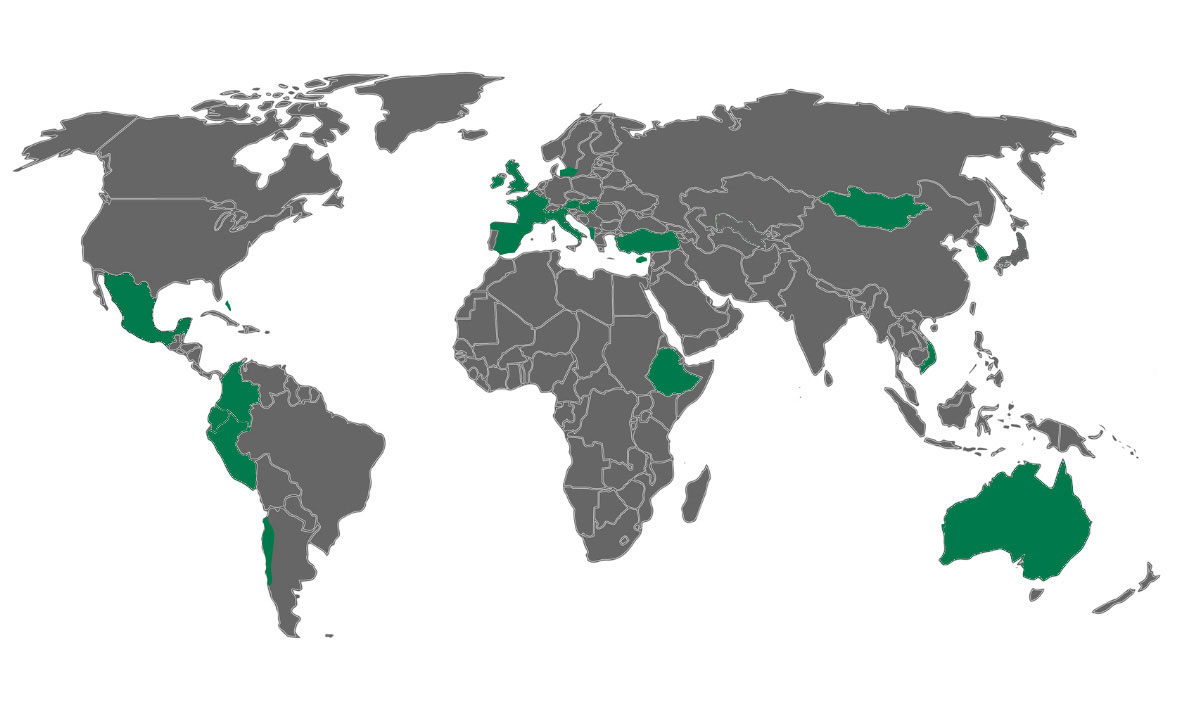
| Country | University | Agreements |
|---|---|---|
| ALBANIA | General Agreement/Collaborative Online International Learning | |
| AUSTRALIA | General Agreement | |
| THE BAHAMAS | Memorandum of Agreement | |
| CHILE |
Collaborative Online International Learning |
|
| COLOMBIA |
General Agreement |
|
| CYPRUS |
Affiliation Agreement |
|
| ECUADOR |
Memorandum of Understanding |
|
| ETHIOPIA | General Agreement | |
| FRANCE | General Agreement | |
| HUNGARY | General Agreement | |
| General Agreement | ||
| General Agreement/Memorandum of Agreement | ||
| IRELAND | Study Abroad Agreement | |
| ITALY | General Agreement | |
| Exchange Agreement | ||
| Affiliation Agreement | ||
| Exchange Agreement/Collaborative Online International Learning | ||
| Memorandum of Understanding/Collaborative Online International Learning | ||
| MEXICO | General Agreement | |
| MONGOLIA | General Agreement | |
| PERU | General/Affiliation Agreement | |
| POLAND | Cooperation Agreement | |
| SOUTH KOREA | Memorandum of Understanding | |
| SPAIN | Memorandum of Understanding | |
| TURKEY | Protocol of Cooperation | |
| UNITED KINGDOM | General Agreement | |
| VIETNAM | General Agreement |