
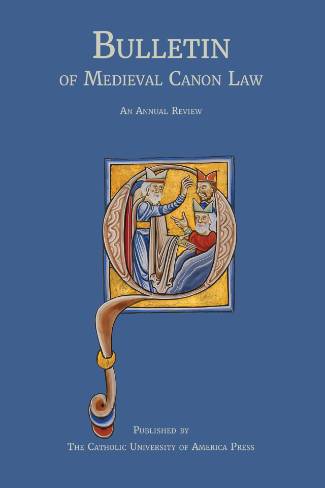
Canon law affected almost every aspect of medieval society. It structured the personnel,
possessions, and liturgical functions of the institutional Church, all of which interacted
with the wider world. It guided and reinforced the conduct of Christians, regardless
of status. It intersected with intellectual and secular legal traditions. Canon law
did not operate in isolation, but rather played an integral role in legal, social,
political, economic, and religious developments.
The Bulletin of Medieval Canon Law (BMCL), published annually, is devoted to examining canon law鈥檚 place in the medieval
world, considering its continued influence in the early modern period, and understanding
its contributions to legal history in general. The journal publishes high-quality
double-blind peer reviewed articles. To help scholars easily find resources, it also
provides a select bibliography of recently published essays and books, review essays,
and a list of digital projects. The BMCL publishes essays in all the major European
languages.
Submission Information:
- Authors should follow the Chicago Manual of Style and refer to the style-sheet and abbreviations document.
- Submissions are accepted on a rolling basis.
- The BMCL is published annually in November.
Publication Information:
BMCL is published by the and can be accessed on
| Executive Editor: | |
|
Melodie H. Eichbauer |
|
|
Editorial Board: |
|
|
Orazio Condorelli Universit脿 degli Studi di Catania |
Franck Roumy Universit茅 Panth茅on-Assas Paris II |
|
Antonia Fiori La Sapienza, Rome |
Danica Summerlin University of Sheffield |
|
Rowan Dorin Standford University |
Jose Miguel Viejo-Ximenez Universidad de Las Palmas de Gran Canaria |
|
Christof Rolker Universit盲t Bamberg |
|