
Computational Perception Laboratory
We are interested in understanding human sensory behavior. We are especially interested in the affective and cognitive aspects of perception, with a focus on visual discomfort and aesthetics. We are also interested in second-order vision and the perception of texture as well. Research in vision science was funded from 2021-2025 by an NIH R-15 AREA Grant: NIH-R15-EY032732-01.
Texture segmentation and scene analysis
Surface segmentation and edge classification
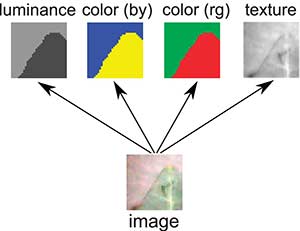 One of the most basic problems faced by biological and artificial visual systems is
how to parse images into regions corresponding to distinct surfaces. Doing so requires
that one detects the edges separating different regions, and to distinguish edges
arising from surface boundaries from those originating from other causes such as changes
in illumination (shadows). This line of work is a collaboration with experimental
neuroscientists and vision scientists at McGill University.
Representative Publications
DiMattina, C., Sterk, E.E., Arena, M.G, & Monteferrante, F.E. (2026). Journal of Vision 26(1): 9.
DiMattina, C. (2025). Vision Research 236, 108695.
DiMattina, C., Burnham, J.J., Guner, B.N., & Yerxa, H.B. (2022). PLoS Computational Biology 18(9): e1010473. [] []
DiMattina, C., Fox, S.A., & Lewicki, M.S. (2012). . Journal of Vision 12(13): 15.
Visual discomfort and aesthetics
Trypophobia and the aesthetics of visual texture
 In the past decade, the behavioral science community has begun systematically investigating
the phenomenon that a large proportion of the general population has an aversion to
patterns containing clusters of bumps and holes. This phenomenon has been termed “Trypophobia�
(fear of holes), and I have been collaborating with Dr. Nate Pipitone (Ä¢¹½TV Psychology)
to better understand the visual characteristics which explain Trypophobia. We are
also invesitgating the neural correlates of visual discomfort and aethetics more broadly
for a variety of other stimuli.
Representative Publications
DiMattina, C., Pipitone, R.N., Renteria, M.R., & Ryan, K. (2024). Scientific Reports 14: 5050.
Pipitone, R.N., DiMattina, C., Martin, E.R., Pavela Banai, I., Bellmore, K.N., DeAngelis, M. (2022). Evaluating the 'skin-disease-avoidance' and 'dangerous-animal' frameworks for understanding Trypophobia. Cognition & Emotion, DOI:
Pipitone, R.N., & DiMattina, C. (2020). . Frontiers in Psychology (Perception Science) 11: 1847.
Journal Articles and Invited Reviews
DiMattina, C., Sterk, E.E., Arena, M.G, & Monteferrante, F.E. (2026). Journal of Vision 26(1): 9.
DiMattina, C. (2025).Vision Research 236, 108695.
DiMattina, C., Pipitone, R.N., Renteria, M.R., & Ryan, K. (2024). Scientific Reports 14: 5050.
DiMattina, C., Burnham, J.J., Guner, B.N., & Yerxa, H.B. (2022). PLoS Computational Biology 18(9): e1010473. [] []
Pipitone, R.N., DiMattina, C., Martin, E.R., Pavela Banai, I., Bellmore, K.N., DeAngelis, M. (2022). Evaluating the 'skin-disease-avoidance' and 'dangerous-animal' frameworks for understanding Trypophobia. Cognition & Emotion, DOI:
DiMattina, C. (2022). Vision Research 190: 107968
DiMattina, C., & Baker, C.L., Jr. (2021). Scientific Reports 11: 10074.
Pipitone, R.N., & DiMattina, C. (2020). . Frontiers in Psychology (Perception Science) 11: 1847.
DiMattina, C., Baker, C.L. Jr. (2019). . PLoS Computational Biology 15(3): e1006829.
DiMattina, C., & Zhang, K. (2017). . In: Encyclopedia of Computational Neuroscience (2nd Ed.). Springer.
DiMattina, C. (2016). . Journal of Vision 16(9): 1.
DiMattina, C. (2015). . Journal of Vision 15(9): 5.
DiMattina, C., & Zhang, K. (2013). . Frontiers in Neural Circuits 7: 101.
DiMattina, C., Fox, S.A., & Lewicki, M.S. (2012). . Journal of Vision 12(13): 15.
DiMattina, C., & Zhang, K. (2011). . Neural Computation 23(9): 2242-2288.
DiMattina, C., & Zhang, K. (2010). . Neural Computation 22(1): 1-47.
DiMattina, C., & Zhang, K. (2008). Neural Computation 20 (3), 668-708.
DiMattina, C., & Wang, X. (2006). . Journal of Neurophysiology 95(2): 1244-1262.
Kotak, V.C., DiMattina, C., & Sanes D.H. (2001). . Journal of Neurophysiology 86(1): 536-540.
Image Databases
Databases of shadow, texture and occlusion patches
Occlusion Databases: , . If you use OSET1 please cite DiMattina et al. (2012).
Shadow Database: . For use of SHAD or OSET2, please cite DiMattina et al. (2022).
Database of 31 Trypophobic Images
. If you use this resource please cite Pipitone & DiMattina (2020).
Database of Disease, Trypophobic and Brodatz Textures
. If you use this resource please cite DiMattina et al. (2023+).
To view more information about Dr. DiMattina, please visit his University Directory listing.
Code can be found at GitHub: